2.24.26 – Bryan Eagle
“TX Task Force Gathers at Texas A&M’s Disaster City”
by Haley Wiggins
Excerpts from this article:
[COMMENTS BY DONNA GARNER: I have always wondered how first-responders know how to perform in various emergencies across the country.
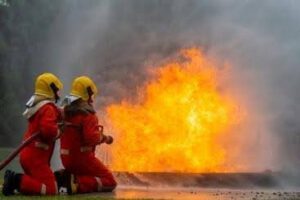
This article explains that Texas A&M University along with various state and federal agencies has a self-created “Disaster City” that simulates various disaster scenes that could occur throughout the world.
Dedicated responders are trained to know exactly what to do in various scenarios.
This fascinating article should make all of us very grateful for those people who may one day save our lives.]
Farrah Lamerech, a firefighter who works with the canine support system, has been with Texas A&M Task Force 1 for about a year.
She said active search-and-rescue exercises such as those practiced at Disaster City in College Station on Saturday gives teams a chance to collaborate and learn from one another.
Lamerech said she always knew she wanted to join a search-and-rescue team, so she started volunteering and fell in love with the work.
She said a job combining her love for animals and her passion for helping others was a position she had to take.
“I was able to come back to my favorite passions and now I'm here and I'm able to give back and keep growing,” Lamerech said.
She received her dog three weeks ago and will train with him for the next year before deploying together.
During training, Lamerech has taken on multiple roles — including serving as a volunteer victim — to better understand how different teams operate.
“So far we've been in different sections of the rubble pile, or what they call the 'strip mall' and the trains," she said Saturday.
"They'll find a spot and they'll give you a role to play and they'll tell you whether you're conscious or unconscious.
If you're conscious, you can act and pretend that you have a broken leg or say something that might make the crews work.”
Lamerech said the training also reassures the community that the task forces are staying ready.
“They're actually preparing themselves, they're practicing, they're using their equipment and familiarizing themselves with all of that so they're not just sitting around and waiting for the next big issue to come up," Lamerech said.
WHAT DISASTER CITY AT TEXAS A&M LOOKS LIKE
More than 250 members of Texas A&M Task Force 1 (TX-TF1), Texas Task Force 2 (TX-TF2), Texas A&M Task Force 3 (TX-TF3) and the Texas Military Department gathered at Disaster City over the weekend to participate in the annual active search-and-rescue exercise.
Disaster City is operated by the Texas A&M Engineering Extension Service (TEEX), a state agency that provides hands-on training, workforce development, and emergency response education.
TEEX is the sponsoring agency of Texas Task Force 1-3 and is part of the Texas A&M University System.
TX-TF1 functions as one of 28 federal teams under the Federal Emergency Management Agency’s National Urban Search and Rescue System and also serves as a statewide team under the Texas Division of Emergency Management.
The 52-acre training facility features collapsible structures designed to simulate disasters and can be customized for specific training needs.
THIS YEAR’S SIMULATED SCENARIO
This year's scenario was based on a Category 4 hurricane that came through the city, leaving buildings destroyed and victims trapped.
Structures on site include removable concrete plates that teams must break through during simulations.
Structural engineers monitor stability and, if needed, advise teams to build stabilizing systems using shoring and breaching techniques before entering.
Jeff Beeson, a medical observer controller, helped facilitate exercises to make them more realistic.
One simulation involved a collapsed office building, where teams used both live-find and human remains canines.
Beeson said approved containers with human remains are hidden in the rubble for dogs to locate.
During deployments, Beeson serves as a physician focusing on the task force member’s health and wellness.
“The number one job I have is to make sure the team is healthy and well, not just when we deploy, but when we spend a lot of time [together] throughout the year, too,” Beeson said.
He emphasized preventative care, noting the importance of quickly addressing illness or injuries.
…“I’m making sure they’re drinking enough water because they’re so focused on their rescue missions, that they often forget to take care of themselves,” Beeson said.
“When we have wide-area searches like today where we're all over the place, we work closely with the leadership to make sure that each squatter team has a medical component so somewhere in every group here you will see one of our medical specialists and they're kind of an extension to the physician.”
IMPORTANCE OF CONTROLLED TRAINING
Jeff Saunders, director of TX-TF1, said Disaster City is their “home playground,” serves as a controlled environment where teams can prepare for unpredictable real-world deployments.
Saunders stated, “This is a very controlled thing so that we know how and it's easier for us to do that after action because we planned a lot and we already know all the answers…
Saunders said it's important for the teams to meet the people that they will be responding with before deployment, so they’re familiar with one another.
“It's a good thing to train with the people that you respond with because it just builds bigger bridges for us. We respond with friends instead of strangers.” Saunders said.
TX-TF1 SENT TO 284 MAJOR U.S. DISASTERS
He added that coordination between local first responders and task forces is one of the main focuses during exercises to make sure that handoff goes smoothly.
Established in 1997, TX-TF1 has deployed 284 times to major disasters including the World Trade Center terrorist attack, the Columbia Shuttle explosion, Hurricanes Katrina, Ike and Harvey, the West fertilizer plant explosion, and California’s Camp Fire…
Through its National Emergency Response and Recovery Training Center, TEEX also provides federally funded homeland security training nationwide and sponsors the Texas A&M Public Works Response Team in addition to TX-TF1.